
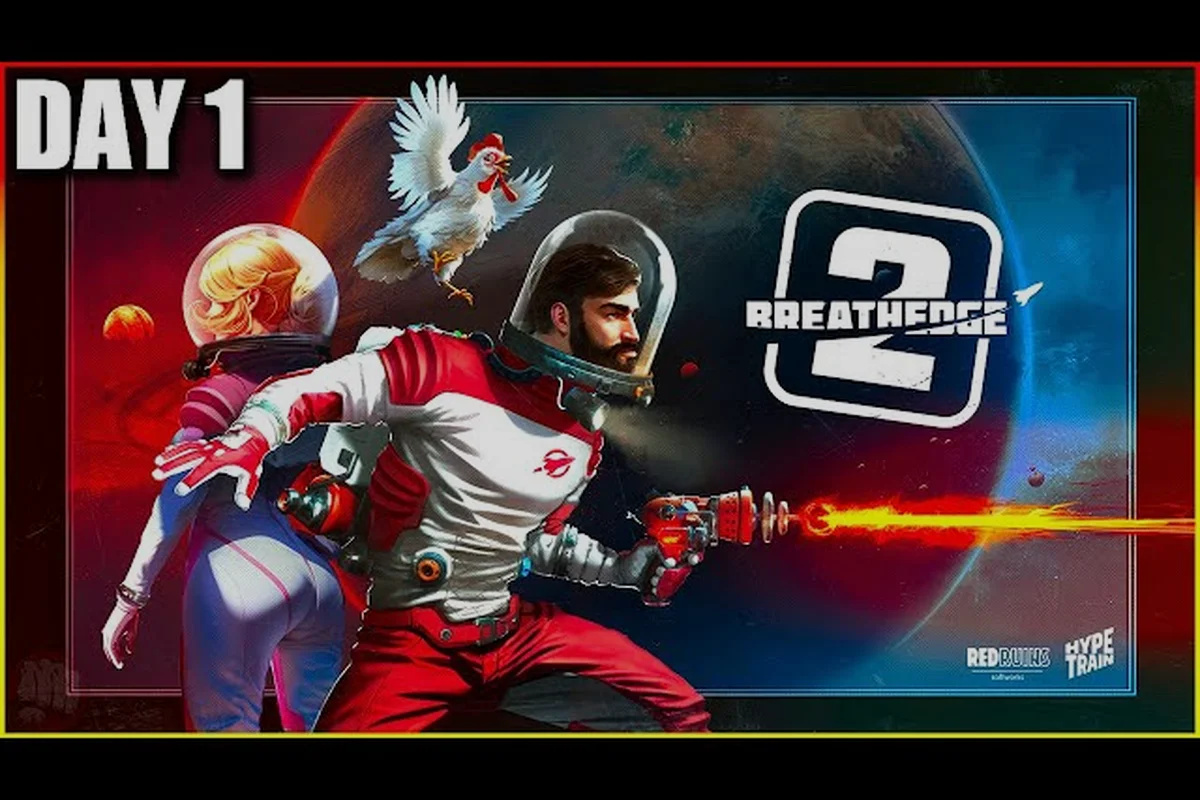
The original Breathedge turned a solitary survival loop into a darkly comic space funeral, but Breathedge 2 changes almost every system that made the first game memorable. Comparing the two titles matters because RedRuins Softworks rebuilt progression, crafting, combat, and exploration around a completely different fantasy: instead of drifting alone with an immortal chicken, you now command a crew, repair a broken warship, and fight an actual war. The sequel keeps the satirical tone while discarding the cramped, corridor-heavy design that frustrated many players in the first game.
Breathedge 2 vs Breathedge: Core Story and Premise Differences
Degradation Removal: Drill Crafting as a "Significant Event"
The most concrete survival-loop change is the removal of item degradation. In Breathedge, tools like the drill broke after a handful of uses, forcing repeated re-crafting cycles that inflated resource grinding. PC Gamer's 2023 preview quotes RedRuins directly: "Now, crafting an item like a drill is a significant event." The crafted drill persists in the sandbox and gains "expanded usefulness" through upgrades. Mechanically, this shifts resource pressure from durability maintenance toward one-time material sinks and upgrade tiers — a direct inversion of the original's wear-and-tear economy.
Transportation Tiers: From Small Vehicles to Personal Spacecraft
Breathedge 2's transportation system represents a new vertical absent from the original. Steam's plan details "small flying and ground vehicles, as well as a personal spacecraft" as distinct progression tiers. The original Breathedge gave players a single spaceship framework with repair and upgrade paths; the sequel splits mobility into vehicle classes spanning surface traversal, atmospheric flight, and dedicated spacecraft operation. This tiered design implies separate crafting trees, fuel or power management per vehicle class, and potentially crew-assisted operation — a structural expansion beyond the first game's single-vehicle loop.
The most immediate Breathedge 2 differences appear in the opening hour. In the original game, the unnamed protagonist wakes up inside a crashed liner filled with corpses, and the entire motivation is transporting your grandfather's coffin to a burial site while a sarcastic AI narrates your failures. The sequel shifts from corpse logistics to crew management, placing you in command of a damaged vessel during what the Steam page calls the Coffinbot war. You are no longer a lone survivor scraping together duct tape; you are a commander making decisions that affect named NPCs with personal goals and needs.
This narrative shift changes how missions are structured. The first game relied on linear checkpoint progression through a series of debris fields, with exploration gated by oxygen timers and durability meters. Breathedge 2 introduces multi-zone open space, including planetary surface gameplay that the original never attempted. According to the official Steam store page, the Early Access version will expand the main story through major updates, adding new areas, characters, quests, and transportation options including ground vehicles and a personal spacecraft.
The tone remains intentionally absurd. The immortal chicken returns, and PC Gamer's reveal preview called the sequel "the funniest take on floating through an uncaring void I've ever seen." However, the comedy now sits atop a more complex simulation layer. The table below summarizes the core premise shifts between the two games:
| Element | Breathedge (Original) | Breathedge 2 |
|---|---|---|
| Player role | Lone survivor with a coffin | Ship commander with a crew |
| Main objective | Bury grandfather in space | Fight the Coffinbot war |
| Companion | Sarcastic AI + immortal chicken | Sarcastic AI + immortal chicken + named crew |
| Setting | Crashed liner, debris corridors | Multi-zone space, planetary surfaces |
| Mission structure | Linear checkpoints | Main quests + side quests + crew goals |
| Tone | Dark satire, isolation humor | Dark satire, war story humor |
Survival Mechanics: Oxygen, Degradation, and Resource Loops
The biggest gameplay overhaul in Breathedge 2 vs Breathedge concerns how items behave. In the original, nearly every crafted tool degraded after a handful of uses, forcing players to constantly rebuild drills, cutters, and oxygen canisters. This durability treadmill dominated the mid-game and created a loop where exploration felt punitive. PC Gamer's preview confirmed that RedRuins specifically removed the annoying degradation mechanic: crafting an item like a drill is now a significant event, and that item stays relevant in the sandbox while being upgraded with expanded usefulness.
Oxygen management also shifts from a punishing countdown to a more forgiving ship systems model. The original forced you to monitor suit oxygen while also juggling food, water, and temperature, often all within the same narrow corridor. The sequel integrates survival into the broader spacecraft management loop: you repair modules, allocate power, and support crew needs rather than micromanaging a single suit gauge. This makes exploration feel expansive instead of claustrophobic.
The crafting system itself becomes deeper without being more tedious. Instead of rebuilding the same broken tool repeatedly, you now upgrade existing equipment along a progression tree that ties into the ship's facilities. Resources still matter, but they feed into long-term investments rather than temporary patches. The table below compares the survival and crafting pillars directly:
| Survival Element | Breathedge (Original) | Breathedge 2 |
|---|---|---|
| Tool durability | Degrades after few uses | No degradation; upgradable |
| Oxygen | Constant suit timer | Ship systems + suit management |
| Food and water | Individual meters | Crew needs + personal supply |
| Crafting loop | Rebuild consumable tools | Upgrade permanent equipment |
| Base building | Limited, corridor-based | Ship modules + planetary outposts |
| Death penalty | Restart from checkpoint | Revised, less punitive |
Combat, Crew Management, and Ship Systems
Combat is where Breathedge 2 most visibly separates itself from the original. The first game offered minimal combat, mostly environmental hazards and the occasional hostile drone, with an emphasis on avoidance over engagement. The sequel introduces melee combat as a core pillar, alongside vehicle-based encounters and ship-to-ship threats tied to the Coffinbot war narrative. You are not just surviving; you are actively fighting through zones and defending your vessel.
Crew management adds a layer the original never touched. Each crew member has individual needs and personal goals, which means your decisions affect morale, efficiency, and story outcomes. This system borrows from colony sims while keeping the scale small enough to remain personal. The ship itself becomes a central hub that requires repair, upgrading, and tactical decision-making during combat sequences.
Vehicles expand the playable space dramatically. The sequel promises small flying and ground vehicles as well as a personal spacecraft, all of which feed into exploration and combat. The original restricted movement to a jetpack and occasional scripted shuttle rides. For players wondering whether the new systems justify the price, the Breathedge 2 Early Access content breakdown explains what ships and crew content arrive on day one versus what lands in later updates. The table below outlines the new mechanical systems and how they compare to the original's feature set:
| System | Breathedge (Original) | Breathedge 2 |
|---|---|---|
| Combat | Minimal, avoidance-focused | Melee combat + vehicle combat |
| Crew | None | Named NPCs with needs and goals |
| Ship management | None | Repair, upgrade, power allocation |
| Vehicles | Jetpack only | Ground vehicles, flyers, personal spacecraft |
| Quest structure | Linear narrative | Main + side quests + crew goals |
| Exploration scope | Debris corridors | Open space + planetary surfaces |
Breathedge 2 Price, Early Access Scope, and Value Assessment
The Immortal Chicken's Expanded Role in Breathedge 2
In the original Breathedge, the Immortal Chicken served as a running gag and occasional interaction point aboard the adrift spaceship. Breathedge 2 carries this mascot forward as a returning companion, but PC Gamer's June 11, 2023 preview confirms RedRuins Softworks deliberately built the sequel around keeping the chicken relevant to core loops rather than relegating it to background flavor. This continuity anchor gives returning players an immediate tonal reference point while new players encounter the chicken through the game's opening systems rather than as a late-game Easter egg.
Early Access Roadmap: Planetary Surface Gameplay
Steam's Early Access plan for Breathedge 2 confirms the 16-20 month EA window will add gameplay on a planetary surface, moving beyond the original's strictly orbital and derelict-station spaces. The roadmap lists new areas, additional characters and quests, and expanded survival and exploration mechanics. For original Breathedge players, this is the largest scope gap: the first game confined traversal to space and station interiors, while the sequel explicitly targets surface exploration as a planned major update during Early Access, not a post-launch stretch goal.
Breathedge 2 enters Steam Early Access on August 31, 2026, with an official EA period estimated at 16 to 20 months before the full release. The Breathedge 2 price has not been locked in our comparison data, but the Early Access model means the launch price may increase as major updates roll out. Players comparing the two games should evaluate what the sequel offers at launch versus what the original delivered at its own full release in February 2021.
The original Breathedge launched as a complete survival experience after nearly three years in Early Access, with a clear ending and a defined scope. Breathedge 2 launches with a partial story, a slice of the planned zones, and a roadmap that includes planetary gameplay, additional characters, and expanded transportation. The Steam page explicitly states that Early Access will gradually expand the main story and add new areas, meaning the day-one experience is intentionally incomplete.
Is Breathedge 2 good for returning players who already finished the original? The answer depends on what you valued in the first game. If you loved the solitary, claustrophobic survival and the constant pressure of repairing broken tools, the sequel's shift toward crew management and permanent equipment may feel like a different genre. If you bounced off the original's durability treadmill and corridor fatigue, the sequel directly addresses both complaints. The value comparison table below breaks down what each game offers at its respective launch:
| Value Factor | Breathedge (Original at launch) | Breathedge 2 (Early Access) |
|---|---|---|
| Content completeness | Complete story at full release | Partial story, expanding |
| Core systems | Survival, crafting, linear quests | Crew, ship, combat, open zones |
| Replayability | Low, linear progression | Higher, crew goals and side quests |
| Price stability | Final price at launch | May increase during EA |
| Target player | Solo survival enthusiasts | Space management + action fans |
| Post-launch support | Patches, console ports | Major content updates planned |
How the Crafting and Upgrade Philosophy Changed
The original Breathedge built its entire progression around scarcity anxiety. Every resource you gathered fed into a tool that would break, forcing you to gather again. This loop created tension but also tedium, especially in the late game when basic repairs required repeated trips through identical corridors. The sequel replaces scarcity anxiety with investment satisfaction: once you craft a drill, a cutter, or a vehicle component, it remains useful and becomes a platform for upgrades.
This philosophy shift affects pacing. The original's opening hours are slow and punishing, with frequent deaths from oxygen mismanagement and tool failures. Breathedge 2's opening hours introduce the ship, the crew, and the combat loop more quickly, letting players feel competent before layering on complexity. The result is a game that respects player time while still offering deep systems.
The upgrade tree ties directly into exploration. Instead of hoarding materials for emergency repairs, you now spend resources on permanent ship modules and equipment enhancements that unlock new traversal options. This creates a positive feedback loop: exploration yields resources, resources fund upgrades, upgrades enable further exploration. The original's loop was negative: exploration consumed resources, resources patched broken tools, broken tools demanded more exploration.
Is Breathedge 2 Worth It for Original Fans?
For players asking is Breathedge 2 worth it, the answer hinges on expectations. The sequel is not a refined version of the original; it is a reimagining that keeps the satirical voice while replacing the core survival loop with a space management simulation. If you want more of the exact same experience, the original still exists and remains a complete product. If you want a more ambitious, systems-driven game that addresses the original's biggest frustrations, the sequel justifies its Early Access entry.
Community feedback from the original's player base, as reported in forums and reviews, consistently criticized the item degradation system and the narrow corridor design. The sequel's developers clearly read those complaints. Removing degradation and opening up multi-zone space with planetary surfaces are direct responses to player feedback. The addition of crew management and combat adds depth that the original lacked, though it also changes the game's identity. The detailed comparison of whether the sequel improves on the original examines the specific quality-of-life changes in more depth. For now, the core Breathedge 2 differences can be summarized as follows:
-
No more durability treadmill — crafted items persist and upgrade
-
Crew with individual needs — management layer replaces pure isolation
-
Open multi-zone space — planetary surfaces expand beyond corridors
-
Active combat — melee and vehicle combat replace avoidance
-
Ship as central hub — repair, upgrade, and defend your vessel
-
Early Access roadmap — 16-20 months of planned content expansion
Frequently Asked Questions
Is Breathedge 2 a direct sequel to Breathedge?
Breathedge 2 continues the satirical space survival universe but shifts the story to a new conflict called the Coffinbot war. You play a ship commander managing a crew rather than a lone survivor transporting a coffin, so the narrative connection is tonal and thematic rather than a direct continuation of the same protagonist's journey.
What are the biggest Breathedge 2 differences from the original?
The largest changes are the removal of item degradation, the addition of crew management, the shift from corridor exploration to open multi-zone space including planetary surfaces, and the introduction of melee and vehicle combat. Crafted items now persist and upgrade instead of breaking after a few uses.
Is Breathedge 2 good for players who disliked the original?
Yes, in most cases. The sequel directly addresses the original's most common complaints: the durability treadmill, narrow corridors, and lack of meaningful combat. If you bounced off the original's repetitive repair loops or claustrophobic level design, Breathedge 2's permanent equipment and open zones may change your opinion.
How much does Breathedge 2 cost?
The Breathedge 2 price has not been confirmed in our comparison data, but the game enters Steam Early Access on August 31, 2026. Early Access titles often increase in price as major updates arrive, so purchasing early may offer a discount compared to the eventual full release price.
Is Breathedge 2 worth it in Early Access?
That depends on your tolerance for incomplete content. The Steam page confirms the story, zones, characters, and vehicles will expand over an estimated 16-20 month Early Access period. If you want a complete experience, wait; if you want to influence development and enjoy the core systems early, the current build may justify the entry cost.